


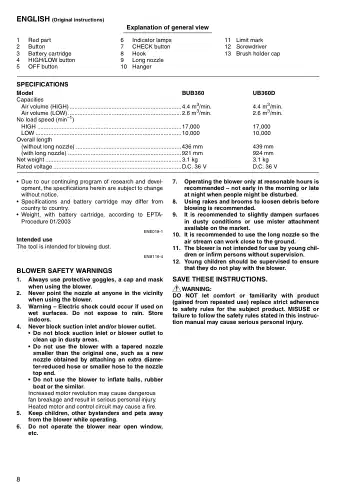

1 Red part 2 Button 3 Battery cartridge 4 HIGH/LOW button 5 OFF button
6 Indicator lamps 7 CHECK button 8 Hook 9 Long nozzle 10 Hanger
11 Limit mark 12 Screwdriver 13 Brush holder cap
Air volume (HIGH) 4.4 m3/min. 4.4 m3/min. Air volume (LOW) 2.6 m3/min. 2.6 m3/min. No load speed (min–1)
HIGH 17,000 17,000 LOW 10,000 10,000 Overall length
(without long nozzle) 436 mm 439 mm (with long nozzle) 921 mm 924 mm Net weight 3.1 kg 3.1 kg Rated voltage D.C. 36 V D.C. 36 V
7. Operating the blower only at reasonable hours is recommended – not early in the morning or late at night when people might be disturbed. 8. Using rakes and brooms to loosen debris before blowing is recommended. 9. It is recommended to slightly dampen surfaces in dusty conditions or use mister attachment available on the market. 10. It is recommended to use the long nozzle so the air stream can work close to the ground. 11. The blower is not intended for use by young chil- dren or infirm persons without supervision. 12. Young children should be supervised to ensure that they do not play with the blower.
ENE018-1 Intended use The tool is intended for blowing dust.
SAVE THESE INSTRUCTIONS.

FUNCTIONAL DESCRIPTION
FOR BATTERY CARTRIDGE 1. Before using battery cartridge, read all instruc- tions and cautionary markings on (1) battery charger, (2) battery, and (3) product using bat- tery. 2. Do not disassemble battery cartridge. 3. If operating time has become excessively shorter, stop operating immediately. It may result in a risk of overheating, possible burns and even an explosion. 4. If electrolyte gets into your eyes, rinse them out with clear water and seek medical attention right away. It may result in loss of your eyesight. 5. Do not short the battery cartridge: (1) Do not touch the terminals with any conduc-
tive material. (2) Avoid storing battery cartridge in a container
with other metal objects such as nails, coins, etc. (3) Do not expose battery cartridge to water or
rain. A battery short can cause a large current flow, overheating, possible burns and even a break- down. 6. Do not store the tool and battery cartridge in locations where the temperature may reach or exceed 50°C (122°F). 7. Do not incinerate the battery cartridge even if it is severely damaged or is completely worn out. The battery cartridge can explode in a fire. 8. Be careful not to drop or strike battery. 9. Do not use a damaged battery.
SAVE THESE INSTRUCTIONS.
Tips for maintaining maximum battery life 1. Charge the battery cartridge before completely discharged. Always stop tool operation and charge the bat- tery cartridge when you notice less tool power. 2. Never recharge a fully charged battery cartridge. Overcharging shortens the battery service life. 3. Charge the battery cartridge with room tempera- ture at 10°C – 40°C (50°F – 104°F). Let a hot bat- tery cartridge cool down before charging it.
Switch action (Fig. 2) To start the tool, simply press the “HIGH/LOW” button. To switch off, press the “OFF” button. To change the tool speed, press the “HIGH/LOW” button. The first press on this button is for high speed and the second press for low speed and then each press on this button repeats the high/low speed cycle alternatively.

Battery remaining capacity indicator (only for models with Battery BL3622A) Battery BL3622A is equipped with the battery remaining capacity indicator. (Fig. 3) Press the CHECK button to indicate the battery remain- ing capacity. The indicator lamps will then light for approx. three seconds.
Blowing (Fig. 7) Hold the blower firmly with a hand and perform the blow- ing operation by moving it around slowly. When blowing around a building, a big stone or a vehicle, direct the nozzle away from them. When performing an operation in corner, start from the corner and then move to wide area.
Cleaning (Fig. 8) From time to time, wipe off the outside of the tool using a cloth dampened in soapy water.
Replacing carbon brushes (Fig. 9 & 10) Remove and check the carbon brushes regularly. Replace when they wear down to the limit mark. Keep the carbon brushes clean and free to slip in the holders. Both carbon brushes should be replaced at the same time. Use only identical carbon brushes. Use a screwdriver to remove the brush holder caps. Take out the worn carbon brushes, insert the new ones and secure the brush holder caps.
To maintain product SAFETY and RELIABILITY, repairs, any other maintenance or adjustment should be per- formed by Makita Authorized Service Centers, always using Makita replacement parts.
If you need any assistance for more details regarding these accessories, ask your local Makita Service Center.
Installing or removing the long nozzle (Fig. 4 & 5) To install the long nozzle, push in onto the blower outlet of the tool all the way. To remove the long nozzle, press its both buttons and with the buttons being pressed pull it out.
Installing the shoulder strap (Fig. 6) Pull the hanger out of the tool. Hook the shoulder strap onto the hanger of the tool. Before use, adjust the length of strap so that it is easy to work with it.

ENG102-3 Noise The typical A-weighted noise level determined according to EN15503:
ENH021-6 For European countries only
Sound pressure level (LpA): 81.2 dB (A) Sound power level (LWA): 93.9 dB (A) Uncertainty (K): 2.5 dB (A)
We Makita Corporation as the responsible manufac- turer declare that the following Makita machine(s):
Designation of Machine: Cordless Blower Model No./ Type: BUB360, UB360D Specifications: see “SPECIFICATIONS” table. are of series production and Conforms to the following European Directives:
ENG900-1 Vibration The vibration total value (tri-axial vector sum) determined according to EN15503:
2000/14/EC, 2006/42/EC And are manufactured in accordance with the following standards or standardised documents:
Work mode: operation without load Vibration emission (ah): 2.5 m/s2 or less Uncertainty (K): 1.5 m/s2
EN15503 The technical documentation is kept by our authorized representative in Europe who is:
Makita International Europe Ltd. Michigan Drive, Tongwell, Milton Keynes, Bucks MK15 8JD, England The conformity assessment procedure required by Direc- tive 2000/14/EC was in Accordance with annex V. Measured Sound Power Level: 92.4 dB Guaranteed Sound Power Level: 96.0 dB
12.11.2009
Makita Corporation 3-11-8, Sumiyoshi-cho, Anjo, Aichi, 446-8502, JAPAN
Wear ear protection · Tomoyasu Kato · Director
Besitzer und unser Team antworten in der Regel innerhalb eines Tages – und Ihre Frage hilft auch anderen weiter.
Stellen Sie die erste Frage — andere Nutzer oder unser Team antworten Ihnen.