





Symbols END004-4 The following show the symbols used for the equipment. Be sure that you understand their meaning before use.
The term “power tool” in the warnings refers to your mains-operated (corded) power tool or battery-operated (cordless) power tool.
Read instruction manual.
Work area safety 1. Keep work area clean and well lit. Cluttered or dark areas invite accidents. 2. Do not operate power tools in explosive atmospheres, such as in the presence of flammable liquids, gases or dust. Power tools create sparks which may ignite the dust or fumes. 3. Keep children and bystanders away while operating a power tool. Distractions can cause you to lose control.
Only for EU countries
Do not dispose of electric equipment or battery pack together with household waste material! In observance of European Directive 2002/96/EC on waste electric and electronic equipment, 2006/66/EC on batteries and accumulators and waste batteries and accumulators and their implementation in accordance with national laws, electric equipment and battery pack that have reached the end of their life must be collected separately and returned to an environmentally compatible recycling facility.
Electrical Safety 4. Power tool plugs must match the outlet. Never modify the plug in any way. Do not use any adapter plugs with earthed (grounded) power tools. Unmodified plugs and matching outlets will reduce risk of electric shock. 5. Avoid body contact with earthed or grounded surfaces such as pipes, radiators, ranges and refrigerators. There is an increased risk of electric shock if your body is earthed or grounded. 6. Do not expose power tools to rain or wet conditions. Water entering a power tool will increase the risk of electric shock. 7. Do not abuse the cord. Never use the cord for carrying, pulling or unplugging the power tool. Keep cord away from heat, oil, sharp edges or moving parts. Damaged or entangled cords increase the risk of electric shock. 8. When operating a power tool outdoors, use an extension cord suitable for outdoor use. Use of a cord suitable for outdoor use reduces the risk of electric shock. 9. If operating a power tool in a damp location is unavoidable, use a ground fault circuit interrupter
Intended use BNE018-1 The tool is intended for blowing dust.
Save all warnings and instructions for future reference.
Cd Ni-MH Li-ion

(GFCI) protected supply. Use of an GFCI reduces the risk of electric shock.
repaired before use. Many accidents are caused by poorly maintained power tools. 22. Keep cutting tools sharp and clean. Properly maintained cutting tools with sharp cutting edges are less likely to bind and are easier to control. 23. Use the power tool, accessories and tool bits etc. in accordance with these instructions, taking into account the working conditions and the work to be performed. Use of the power tool for operations different from those intended could result in a hazardous situation.
Personal Safety 10. Stay alert, watch what you are doing and use common sense when operating a power tool. Do not use a power tool while you are tired or under the influence of drugs, alcohol or medication. A moment of inattention while operating power tools may result in serious personal injury. 11. Use personal protective equipment. Always wear eye protection. Protective equipment such as dust mask, non-skid safety shoes, hard hat, or hearing protection used for appropriate conditions will reduce personal injuries. 12. Prevent unintentional starting. Ensure the switch is in the off-position before connecting to power source and/or battery pack, picking up or carrying the tool. Carrying power tools with your finger on the switch or energising power tools that have the switch on invites accidents. 13. Remove any adjusting key or wrench before turning the power tool on. A wrench or a key left attached to a rotating part of the power tool may result in personal injury. 14. Do not overreach. Keep proper footing and balance at all times. This enables better control of the power tool in unexpected situations. 15. Dress properly. Do not wear loose clothing or jewellery. Keep your hair, clothing, and gloves away from moving parts. Loose clothes, jewellery or long hair can be caught in moving parts. 16. If devices are provided for the connection of dust extraction and collection facilities, ensure these are connected and properly used. Use of dust collection can reduce dust-related hazards.
Battery tool use and care 24. Recharge only with the charger specified by the manufacturer. A charger that is suitable for one type of battery pack may create a risk of fire when used with another battery pack. 25. Use power tools only with specifically designated battery packs. Use of any other battery packs may create a risk of injury and fire. 26. When battery pack is not in use, keep it away from other metal objects, like paper clips, coins, keys, nails, screws or other small metal objects, that can make a connection from one terminal to another. Shorting the battery terminals together may cause burns or a fire. 27. Under abusive conditions, liquid may be ejected from the battery; avoid contact. If contact accidentally occurs, flush with water. If liquid contacts eyes, additionally seek medical help. Liquid ejected from the battery may cause irritation or burns.
Service 28. Have your power tool serviced by a qualified repair person using only identical replacement parts. This will ensure that the safety of the power tool is maintained. 29. Follow instruction for lubricating and changing accessories. 30. Keep handles dry, clean and free from oil and grease.
Power tool use and care 17. Do not force the power tool. Use the correct power tool for your application. The correct power tool will do the job better and safer at the rate for which it was designed. 18. Do not use the power tool if the switch does not turn it on and off. Any power tool that cannot be controlled with the switch is dangerous and must be repaired. 19. Disconnect the plug from the power source and/or the battery pack from the power tool before making any adjustments, changing accessories, or storing power tools. Such preventive safety measures reduce the risk of starting the power tool accidentally. 20. Store idle power tools out of the reach of children and do not allow persons unfamiliar with the power tool or these instructions to operate the power tool. Power tools are dangerous in the hands of untrained users. 21. Maintain power tools. Check for misalignment or binding of moving parts, breakage of parts and any other condition that may affect the power tool's operation. If damaged, have the power tool
1. Always use protective goggles, a cap and mask when using the blower. 2. Never point the nozzle at anyone in the vicinity when using the blower. 3. Always use the dust bag when collecting dust, chips and the like. 4. Do not collect still smoldering cigarette ashes, freshly cut metals shavings, screws, nails and the like. Warning - Electric shock could occur if used on wet surfaces. Do not expose to rain. Store indoors. 5. Never block suction inlet and/or blower outlet. Increased motor revolution may cause dangerous fan breakage. 6. The blower is not intended for use by young children or infirm persons without supervision.

SAVE THESE INSTRUCTIONS.
FOR BATTERY CARTRIDGE
1. Before using battery cartridge, read all instructions and cautionary markings on (1) battery charger, (2) battery, and (3) product using battery. 2. Do not disassemble battery cartridge. 3. If operating time has become excessively shorter, stop operating immediately. It may result in a risk of overheating, possible burns and even an explosion. 4. If electrolyte gets into your eyes, rinse them out with clear water and seek medical attention right away. It may result in loss of your eyesight. 5. Do not short the battery cartridge: (1) Do not touch the terminals with any conductive material. (2) Avoid storing battery cartridge in a container with other metal objects such as nails, coins, etc. (3) Do not expose battery cartridge to water or rain. A battery short can cause a large current flow, overheating, possible burns and even a breakdown. 6. Do not store the tool and battery cartridge in locations where the temperature may reach or exceed 50°C (122°F). 7. Do not incinerate the battery cartridge even if it is severely damaged or is completely worn out. The battery cartridge can explode in a fire. 8. Be careful not to drop or strike battery. 9. Do not use a damaged battery.
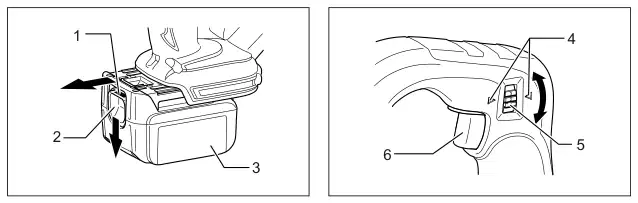
Air volume adjusting dial Air volume can be adjusted to any of three settings by turning the adjusting dial with the switch trigger fully depressed. Refer to the table below for the relationship between the number on the dial and the air volume.
SAVE THESE INSTRUCTIONS.
Tips for maintaining maximum battery life 1. Charge the battery cartridge before completely discharged. Always stop tool operation and charge the battery cartridge when you notice less tool power. 2. Never recharge a fully charged battery cartridge. Overcharging shortens the battery service life. 3. Charge the battery cartridge with room temperature at 10°C - 40°C (50°F - 104°F). Let a hot battery cartridge cool down before charging it.
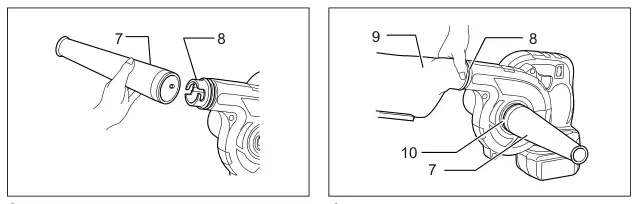
Blowing For dust blowing, attach nozzle to blower outlet, turning clockwise to lock it in place. (Fig. 3)
Dust suction (Fig. 4) For dust suction, fit nozzle onto suction inlet and dust bag onto blower outlet.

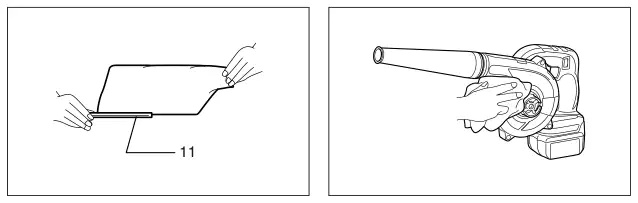
After the bag fills with dust, empty the contents of the dust bag into a dust bin by releasing the fastener. (Fig. 5)
Cleaning From time to time, wipe off the outside of the tool using a cloth dampened in soapy water. Never use gasoline, thinner or the like, or discoloration and/or cracks can take place. (Fig. 6) To maintain product SAFETY and RELIABILITY, repairs, any other maintenance or adjustment should be performed by Makita Authorized Service Centers, always using Makita replacement parts.
For European countries only ENH101-14 EC Declaration of Conformity We Makita Corporation as the responsible manufacturer declare that the following Makita machine(s): Designation of Machine: Cordless Blower Model No./ Type: BUB142, BUB182 are of series production and Conforms to the following European Directives:
2006/42/EC And are manufactured in accordance with the following standards or standardised documents:
EN60745 The technical documentation is kept by our authorised representative in Europe who is:
Makita International Europe Ltd. Michigan Drive, Tongwell, Milton Keynes, MK15 8JD, England
Director Makita Corporation 3-11-8, Sumiyoshi-cho, Anjo, Aichi, JAPAN
Noise ENG905-1 The typical A-weighted noise level determined according to EN60745:
Model BUB142 Sound pressure level (LpA): 86 dB (A) Sound power level (LWA): 97 dB (A) Uncertainty (K): 3 dB (A)
Model BUB182 Sound pressure level (LpA): 83 dB (A) Sound power level (LWA): 94 dB (A) Uncertainty (K): 3 dB (A)
Wear ear protection. Vibration ENG900-1 The vibration total value (tri-axial vector sum) determined according to EN60745:
Work mode: operation without load Vibration emission (ah): 2.5 m/s2 or less Uncertainty (K): 1.5 m/s2
Tomoyasu Kato
Besitzer und unser Team antworten in der Regel innerhalb eines Tages – und Ihre Frage hilft auch anderen weiter.
Stellen Sie die erste Frage — andere Nutzer oder unser Team antworten Ihnen.