


P Roçadeira a bateria/ Manual de instruções Aparador de grama a bateria
GR Θαμνοκοπτικό μπαταρίας/ Οδηγίες χρήσης Θαμνοκοπτικό μπαταρίας με μεσηνέζα
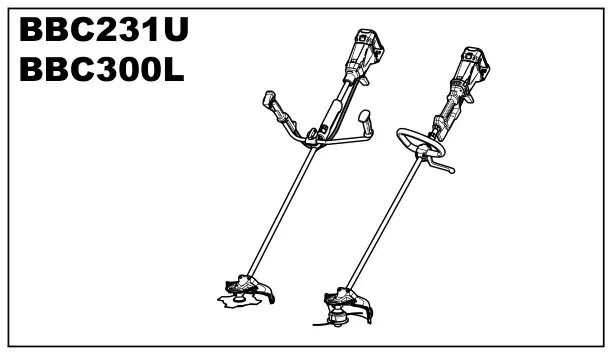










Symbols END008-1 The following show the symbols used for the equipment. Be sure that you understand their meaning before use.
Do not expose to moisture.
Top permissible tool speed.
Take particular care and attention.
Only for EU countries
Read instruction manual.
Do not dispose of electric equipment or battery pack together with household waste material! In observance of European Directive 2002/96/EC on waste electric and electronic equipment, 2006/66/EC on batteries and accumulators and waste batteries and accumulators and their implementation in accordance with national laws, electric equipment and battery pack that have reached the end of their life must be collected separately and returned to an environmentally compatible recycling facility.
Danger; be aware of thrown objects.
The distance between the tool and
bystanders must be at least 15 m.
Keep bystanders away.
Keep distance at least 15 m.
Avoid kickback.
Wear a helmet, goggles and ear
protection.
Intended use ENE074-1 The equipment is intended for cutting grass, weeds, bushes and undergrowth.
Wear protective gloves.
Wear sturdy boots with nonslip soles.
Steeltoed safety boots are recommended.
Cd Ni-MH Li-ion

instructions may result in electric shock, fire and/or serious injury.
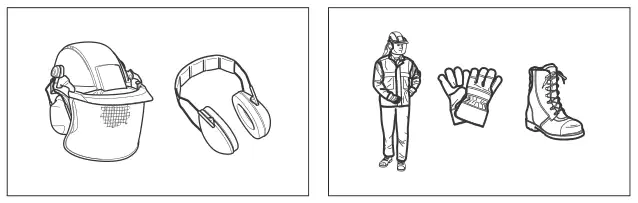
3. Always wear a helmet where there is a risk of falling objects. The protective helmet is to be checked at regular intervals for damage and is to be replaced at the latest after 5 years. Use only approved protective helmets. 4. The visor of the helmet (or alternatively goggles) protects the face from flying debris and stones. During operation of the equipment always wear goggles, or a visor to prevent eye injuries. 5. Wear adequate noise protection equipment to avoid hearing impairment (ear muffs, ear plugs etc.). (Fig. 2) 6. The work overalls protect against flying stones and debris. It is strongly recommended that the user wears work overalls. 7. Special gloves made of thick leather are part of the prescribed equipment and must always be worn during operation of the equipment. 8. When using the equipment, always wear sturdy shoes with a nonslip sole. This protects against injuries and ensures a good footing.
Save all warnings and instructions for future reference.
General instructions 1. To ensure correct operation, user has to read this instruction manual to make himself familiar with the handling of the equipment. Users insufficiently informed will risk danger to themselves as well as others due to improper handling. 2. It is recommended only to lend the equipment to people who have proven to be experienced with brushcutters/string trimmers. Always hand over this instruction manual. 3. First users should ask the dealer for basic instructions to familiarize oneself with the handling of brushcutters/ string trimmers. 4. Never allow people unfamiliar with these instructions, people (including children) with reduced physical, sensory or mental capabilities, or lack of experience and knowledge to use the equipment. Local regulations can restrict the age of the operator. 5. Use the equipment with the utmost care and attention. 6. Operate the equipment only if you are in good physical condition. Perform all work calmly and carefully. Use common sense and keep in mind that the operator or user is responsible for accidents or hazards occurring to other people or their property. 7. Never use the equipment after consumption of alcohol or drugs, or if feeling tired or ill. 8. The motor is to be switched off immediately in case that the equipment shows any problem or abnormal sign. 9. Switch off and remove the battery cartridge when resting and when leaving the equipment unattended, and place it in a safe location to prevent danger to others or damage to the equipment. 10. Don’t force the equipment. it will do the job better and with less likelihood of a risk of injury at the rate for which it was designed. 11. Don’t overreach. Keep proper footing and balance at all times.
Electrical and battery safety 1. Avoid dangerous environment. Don’t use the equipment in damp or wet locations or expose it to rain. Water entering an equipment will increase the risk of electric shock. 2. Recharge only with the charger specified by the manufacturer. A charger that is suitable for one type of battery pack may create a risk of fire when used with another battery pack. 3. Use power tools only with specifically designated battery packs. Use of any other battery packs may create a risk of injury and fire. 4. When battery pack is not in use, keep it away from other metal objects, like paper clips, coins, keys, nails, screws or other small metal objects, that can make a connection from one terminal to another. Shorting the battery terminals together may cause burns or a fire. 5. Under abusive conditions, liquid may be ejected from the battery; avoid contact. If contact accidentally occurs, flush with water. If liquid contacts eyes, additionally seek medical help. Liquid ejected from the battery may cause irritation or burns. 6. Do not dispose of the battery(ies) in a fire. The cell may explode. Check with local codes for possible special disposal instructions. 7. Do not open or mutilate the battery(ies). Released electrolyte is corrosive and may cause damage to the eyes or skin. It may be toxic if swallowed.
Intended use of the equipment 1. Use right equipment. The cordless brushcutter/string trimmer is only intended for cutting grass, weeds, bushes and undergrowth. It should not be used for any other purpose such as edging or hedge cutting as this may cause injury.
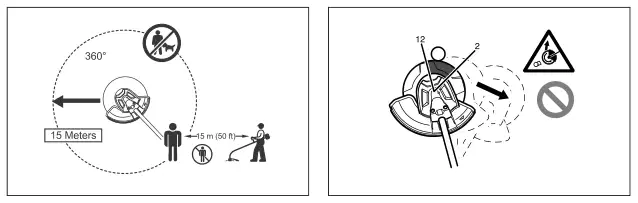
Starting up the equipment (Fig. 3) 1. Make sure that there are no children or other people within a working range of 15 meters (50 ft), also pay attention to any animals in the working vicinity. Otherwise stop using the equipment. 2. Before use always check that the equipment is safe for operation. Check the security of the cutting tool and the guard and the switch trigger/lever for easy and proper action. Check for clean and dry handles and test the function of the start/stop. 3. Check damaged parts before further use of the equipment. A guard or other part that is damaged should be carefully checked to determine that it will operate properly and perform its intended function.
Personal protective equipment 1. Dress Properly. The clothing worn should be functional and appropriate, i.e. it should be tight-fitting but not cause hindrance. Do not wear either jewelry or clothing which could become entangled with bushes or shrubs. Wear protective hair covering to contain long hair. 2. In order to avoid either head, eye, hand or foot injuries as well as to protect your hearing the following protective equipment and protective clothing must be used during operation of the equipment. (Fig. 1)

Check for alignment of moving parts, binding of moving parts, breakage of parts, mounting, and any other condition that may affect its operation. A guard or other part that is damaged should be properly repaired or replaced by our authorized service center unless indicated elsewhere in this manual. 4. Switch on the motor only when the hands and feet are away from the cutting tool. 5. Before starting make sure that the cutting tool has no contact with hard objects such as branches, stones etc. as the cutting tool will revolve when starting.
Kickback (blade thrust) 1. When operating the equipment, uncontrolled kickback (blade thrust) may occur. (Fig. 4) 2. This is particularly the case when attempting to cut within a blade segment between 12 and 2 o’clock. 3. Never apply the equipment within a segment between 12 and 2 o’clock. 4. Never apply this segment of the cutter blade to solids, such as bushes and trees, etc., having a diameter in excess of 3 cm or the cutter blade will be deflected at great force with the risk of injuries.
Method of operation 1. Only use the equipment in good light and visibility. During the winter season beware of slippery or wet areas, ice and snow (risk of slipping). Always ensure a safe footing. 2. Take care against injury to feet and hands from the cutting tool. 3. Never cut above waist height. 4. Never stand on a ladder and run the equipment. 5. Never climb up into trees to perform cutting operation with the equipment. 6. Never work on unstable surfaces. 7. Remove sand, stones, nails etc. found within the working range. Foreign particles may damage the cutting tool and can cause dangerous kick-backs. 8. Should the cutting tool hit stones or other hard objects, immediately switch off the motor and inspect the cutting tool. 9. Inspect the cutting tool at short regular intervals for damage (detection of hairline cracks by means of tapping-noise test). 10. Before commencing cutting, the cutting tool must have reached full working speed. 11. Operate the equipment only with the shoulder harness attached which is to be suitably adjusted before putting the equipment into operation. It is essential to adjust the shoulder harness according to the user size to prevent fatigue occurring during use. 12. During operation always hold the equipment with both hands. Never hold the equipment with one hand during use. Always ensure a safe footing. 13. The cutting tool has to be equipped with the appropriate guard. Never run the equipment with damaged guards or without guards in place! 14. All protective installations and guards supplied with the equipment must be used during operation. 15. Never use the equipment striking or bumping the weeds or similar to cut away them. 16. Except in case of emergency, never drop or cast the equipment to the ground or this may severely damage the equipment. 17. Remember to lift the entire equipment from the ground when moving the equipment. 18. Always remove the battery cartridge from the equipment: - whenever leaving the equipment unattended; - before clearing a blockage; - before checking, cleaning or working on the
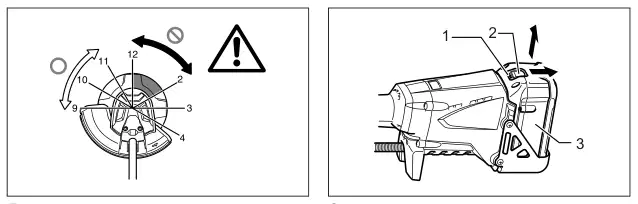
To avoid kickbacks, observe the following: 1. Operation within a blade segment between 12 and 2 o’clock presents positive hazards, especially when using metal cutting tools. (Fig. 5) 2. Cutting operations within a blade segment between 11 and 12 o’clock, and between 2 and 5 o’clock, must only be performed by trained and experienced operators, and then only at their own risk. 3. Easy cutting with almost no kickback is possible within a blade segment between 9 and 11 o’clock.
Cutting Tools 1. Employ only the correct cutting tool for the job in hand. 2. To cut thick materials, such as weed, high grass, bushes, shrubs, underwood, thicket etc. (max. 2 cm dia. thickness), perform the cutting work by swinging the equipment evenly in half-circles from right to left (similar to using a scythe).
Maintenance instructions 1. The condition of the equipment, in particular of the cutting tool of the protective devices and also of the shoulder harness must be checked before commencing work. 2. Particular attention is to be paid to the cutting blades which must be correctly sharpened. 3. Turn off the motor and remove the battery cartridge before carrying out maintenance, replacing/ sharpening cutting tools or cleaning the equipment or cutting tool. 4. Check loose fasteners and damaged parts such as cracks in the cutting attachment. 5. Follow instructions for lubricating and changing accessories. 6. When not in use, store the equipment indoors in dry and high or locked-up place - out of the reach of children. Clean and maintain before storage. 7. Use only the manufacturer’s recommended replacement parts and accessories. 8. Inspect and maintain the equipment regularly, especially before/after use. Have the equipment repaired only by our authorized service center. 9. Keep handles dry, clean and free from oil and grease.
equipment; - after striking a foreign object; - whenever the equipment starts vibrating abnormally.
SAVE THESE INSTRUCTIONS.

FOR BATTERY CARTRIDGE
1. Before using battery cartridge, read all instructions and cautionary markings on (1) battery charger, (2) battery, and (3) product using battery. 2. Do not disassemble battery cartridge. 3. If operating time has become excessively shorter, stop operating immediately. It may result in a risk of overheating, possible burns and even an explosion. 4. If electrolyte gets into your eyes, rinse them out with clear water and seek medical attention right away. It may result in loss of your eyesight. 5. Do not short the battery cartridge: (1) Do not touch the terminals with any
conductive material. (2) Avoid storing battery cartridge in a container
with other metal objects such as nails, coins, etc. (3) Do not expose battery cartridge to water or
rain. A battery short can cause a large current flow, overheating, possible burns and even a breakdown. 6. Do not store the tool and battery cartridge in locations where the temperature may reach or exceed 50°C (122°F). 7. Do not incinerate the battery cartridge even if it is severely damaged or is completely worn out. The battery cartridge can explode in a fire. 8. Be careful not to drop or strike battery. 9. Do not use dropped or struck battery.
SAVE THESE INSTRUCTIONS.
Tips for maintaining maximum battery life 1. Charge the battery cartridge before completely discharged. Always stop tool operation and charge the battery cartridge when you notice less tool power. 2. Never recharge a fully charged battery cartridge. Overcharging shortens the battery service life. 3. Charge the battery cartridge with room temperature at 10°C - 40°C (50°F - 104°F). Let a hot battery cartridge cool down before charging it.


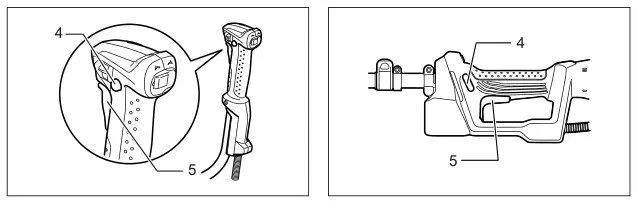
CAUTION: • Before inserting the battery cartridge into the equipment, always check to see that the switch trigger actuates properly and returns to the “OFF” position when released. (Fig. 7 & 8) To prevent the switch trigger from being accidentally pulled, a lock-off button is provided. To start the equipment, depress the lock-off button and pull the switch trigger. The tool speed is increased by increasing pressure on the switch trigger. Release the switch trigger to stop.

cannot be removed in spite of using the reversing switch.
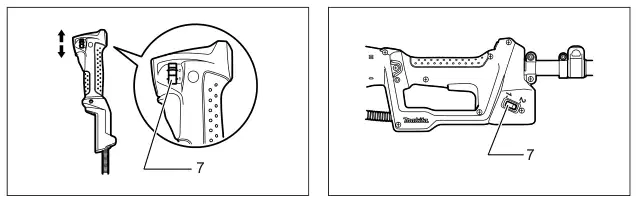
Speed change (Fig. 11 & 12) Two speed ranges can be preselected with the speed change switch. To change the speed range, turn the speed change switch lever so that it points toward “1” for low speed or “2” for high speed.
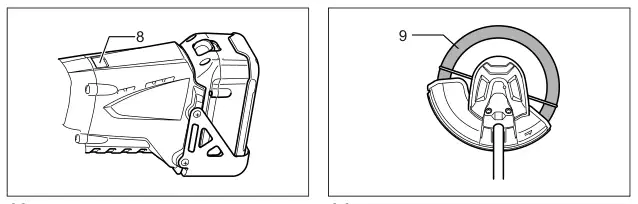
Battery/motor protection system The battery cartridge and machine are equipped with protection systems, which automatically reduces or cuts off the output power for their long service life. Under overloaded situation, the protector drops the revolution to protect the motor. In this case, the following two indication lamps do not light up or blink. The other functions can be recognized by two indication lamps as follows when working. (Fig. 13)
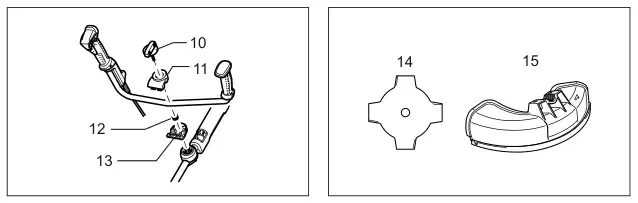
Place handle between handle clamp and handle holder. Adjust the handle to an angle that provides a comfortable working position and then secure by firmly hand- tightening knob.
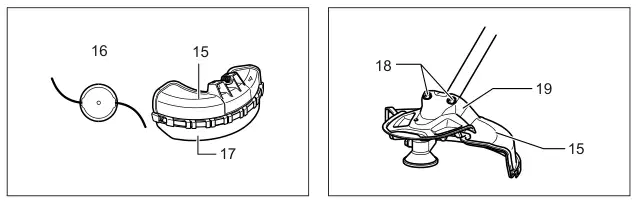
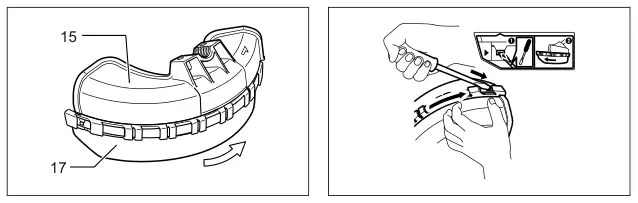
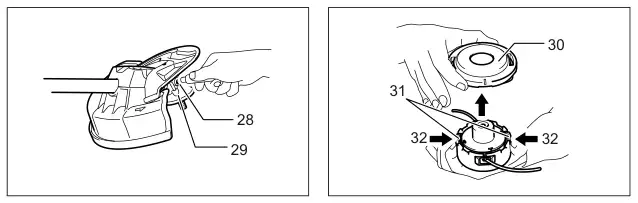
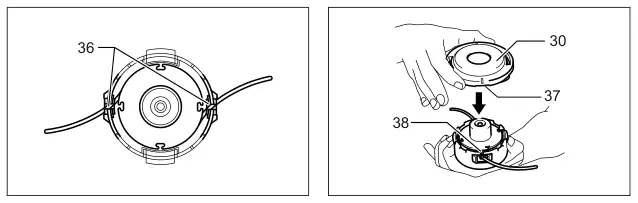
CAUTION: • Do not bump the head when it rotates greater than 4,500 min-1 or it is stopped. (Fig. 14) The nylon cutting head is a dual string trimmer head with bump & feed mechanisms. Bump the nylon cutting head against the ground to feed out extra cord during driving the equipment. The cord will be automatically cut to the appropriate length by the cutter on the guard extension.
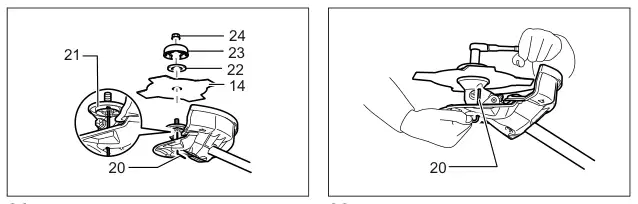
In use of the metal blade (Fig. 18) Fix the guard to the clamp with two bolts as shown. Tighten the right and left bolts evenly.
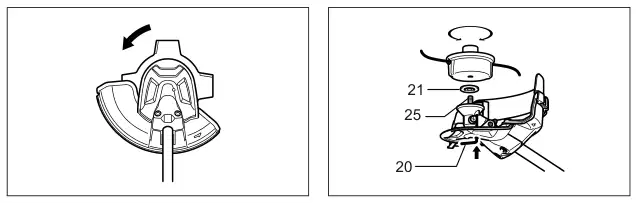
In use of the nylon cutting head
Installing the handle (for bike handle type model only) (Fig. 15) Loosen knob.

Installing the cutter blade
WARNING: • Always position the equipment on your right-hand side so that the shaft of the left handle is always ahead of you. The correct posture reduces the risk of injury caused by kickback. (Fig. 25) Fit the shoulder harness as shown and hang the machine firmly on your right side so that the shaft of the left handle is always ahead of you.
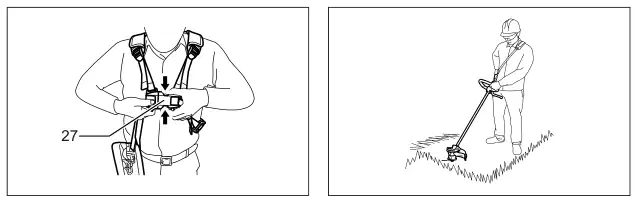
Attachment of shoulder harness (Fig. 26) Wear the shoulder harness on your back and buckle it up until a click is heard. Make sure that it cannot be taken off with pulling it off. Hang the machine as shown. Adjust the strap length so that the cutter blade will be kept parallel with the ground at the level of 10 to 30 cm above the ground.
Detachment (Fig. 27) In case of emergency, press the lever of the buckle strongly to take off the harness and the machine.
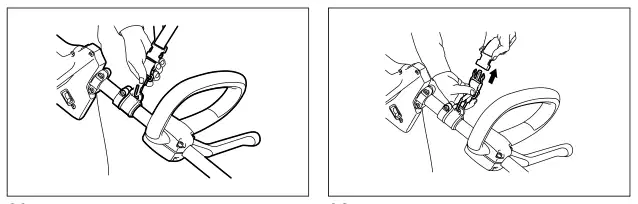
Attachment of shoulder harness (Fig. 29) Hang the shoulder harness on your left shoulder with putting your head and right arm though it. Buckle it to the hook unit until a click is heard. Make sure that it cannot be taken off with pulling it off. Hang the machine as shown. Adjust the strap length so that the cutter blade will be kept parallel with the ground at the level of 10 to 30 cm above the ground.
Detachment (Fig. 30) In case of emergency, press the emergency detachment lever strongly.
Correct posture · Correct posture

Supply of grease to gear case (Fig. 31) Supply grease (Shell Alvania 2 or equivalent) to the gear case through the grease hole every 30 hours. (Genuine Makita grease may be purchased from your Makita dealer.)
To maintain product SAFETY and RELIABILITY, repairs, any other maintenance or adjustment should be performed by Makita Authorized Service Centers, always using Makita replacement parts.

manual, do not rashly dismantle the equipment. Instead, ask Makita Authorized Service Centers, always using Makita replacement parts for repairs.
Before asking for repairs, conduct your own inspection first. If you find a problem that is not explained in the
Malfunction status Cause Action
Battery cartridge is not installed. Install the battery cartridge.
Battery problem (under voltage) Recharge the battery. If recharging is not effective, replace battery.
Motor does not run.
The drive system does not work correctly.
Ask your local authorized service center for repair.
Rotation is reverse. Change the direction of rotation with the reversing switch.
Motor stops in a while after start.
Battery is nearly flat. Recharge the battery. If recharging is not effective, replace battery.
Overheating. Rest the equipment for a while.
Battery is installed improperly. Install the battery cartridge as described in this manual.
Revolution does not achieve the appropriate speed.
Battery power is dropping. Recharge the battery. If recharging is not effective, replace battery.
The drive system does not work correctly.
Ask your local authorized service center for repair.
Foreign object such as a branch is jamming between the guard and the cutting tool.
Remove the foreign object.
Cutting tool does not rotate: Stop the machine immediately!
Cutter blade fastening nut is loose. Tighten the nut properly as described in this manual.
The cutter blade is bended. Replace the cutter blade.
The drive system does not work correctly.
Ask your local authorized service center for repair.
Bump the nylon cutting head against the ground during driving the equipment to feed the cord.
One end of the nylon cord has been broken.
The cutter blade is bended, cracked or worn. Replace the cutter blade.
Abnormal vibration: Stop the machine immediately!
Cutter blade fastening nut is loose. Tighten the nut properly as described in this manual. Cutter blade is fastened improperly.
The drive system does not work correctly.
Ask your local authorized service center for repair.
Cutting tool and motor cannot stop: Remove the battery immediately! Electric or electronic malfunction. Remove the battery and ask your local authorized service center for repair.
For Model BBC231U Noise ENG104-2 The typical A-weighted noise level determined according to ISO22868:
Sound pressure level (LpA): 79.7 dB (A) Uncertainty (K): 2.5 dB (A) The noise level under working may exceed 80 dB (A).
Wear ear protection. Vibration ENG244-1 The vibration emission value determined according to ISO22867, EN786:

For Model BBC300L Noise ENG104-2 The typical A-weighted noise level determined according to EN786:
The technical documentation is kept by our authorised representative in Europe who is:
Makita International Europe Ltd., Michigan, Drive, Tongwell, Milton Keynes, MK15 8JD, England The conformity assessment procedure required by Directive 2000/14/EC was in Accordance with annex VIII. Notified Body:
Sound pressure level (LpA): 79.3 dB (A) Uncertainty (K): 2.5 dB (A) The noise level under working may exceed 80 dB (A).
Wear ear protection. Vibration ENG244-1 The vibration emission value determined according to EN786:
TÜV Rheinland Product Safety GmbH, Am Grauen Stein D-51105 Köln, identification no. 0197 Measured Sound Power Level: 91.3 dB Guaranteed Sound Power Level: 93 dB
For European countries only ENH021-5 EC Declaration of Conformity We Makita Corporation as the responsible manufacturer declare that the following Makita machine(s):
Designation of Machine: Cordless Brushcutter Model No./ Type: BBC231U Specifications: see “SPECIFICATIONS” table. are of series production and Conforms to the following European Directives:
Director Makita Corporation 3-11-8, Sumiyoshi-cho, Anjo, Aichi, JAPAN
2000/14/EC, 2006/42/EC And are manufactured in accordance with the following standards or standardised documents:
EN60745, ISO11806 The technical documentation is kept by our authorised representative in Europe who is:
Makita International Europe Ltd., Michigan, Drive, Tongwell, Milton Keynes, MK15 8JD, England The conformity assessment procedure required by Directive 2000/14/EC was in Accordance with annex V. Measured Sound Power Level: 93.6 dB Guaranteed Sound Power Level: 95 dB
Director Makita Corporation 3-11-8, Sumiyoshi-cho, Anjo, Aichi, JAPAN
For European countries only ENH212-10 EC Declaration of Conformity We Makita Corporation as the responsible manufacturer declare that the following Makita machine(s):
Designation of Machine: Cordless String Trimmer Model No./ Type: BBC300L Specifications: see “SPECIFICATIONS” table. are of series production and Conforms to the following European Directives:
2000/14/EC, 2006/42/EC And are manufactured in accordance with the following standards or standardised documents:
Häufige Probleme, wahrscheinliche Ursachen und Lösungen.
| Problem | Mögliche Ursache | Abhilfe | |
|---|---|---|---|
| Motor does not run. | Battery cartridge is not installed. | Install the battery cartridge. | p.15 |
| Motor does not run. | Battery problem (under voltage) | Recharge the battery. If recharging is not effective, replace battery. | p.15 |
| Motor does not run. | The drive system does not work correctly. | Ask your local authorized service center for repair. | p.15 |
| Motor stops in a while after start. | Rotation is reverse. | Change the direction of rotation with the reversing switch. | p.15 |
| Motor stops in a while after start. | Battery is nearly flat. | Recharge the battery. If recharging is not effective, replace battery. | p.15 |
| Motor stops in a while after start. | Overheating. | Rest the equipment for a while. | p.15 |
| Revolution does not achieve the appropriate speed. | Battery is installed improperly. | Install the battery cartridge as described in this manual. | p.15 |
| Revolution does not achieve the appropriate speed. | Battery power is dropping. | Recharge the battery. If recharging is not effective, replace battery. | p.15 |
| Revolution does not achieve the appropriate speed. | The drive system does not work correctly. | Ask your local authorized service center for repair. | p.15 |
| Cutting tool does not rotate: Stop the machine immediately! | Foreign object such as a branch is jamming between the guard and the cutting tool. | Remove the foreign object. | p.15 |
| Cutting tool does not rotate: Stop the machine immediately! | Cutter blade fastening nut is loose. | Tighten the nut properly as described in this manual. | p.15 |
| Cutting tool does not rotate: Stop the machine immediately! | The cutter blade is bended. | Replace the cutter blade. | p.15 |
| Cutting tool does not rotate: Stop the machine immediately! | The drive system does not work correctly. | Ask your local authorized service center for repair. | p.15 |
| Abnormal vibration: Stop the machine immediately! | One end of the nylon cord has been broken. | Bump the nylon cutting head against the ground during driving the equipment to feed the cord. | p.15 |
| Abnormal vibration: Stop the machine immediately! | The cutter blade is bended, cracked or worn. | Replace the cutter blade. | p.15 |
| Abnormal vibration: Stop the machine immediately! | Cutter blade fastening nut is loose. | Tighten the nut properly as described in this manual. | p.15 |
| Abnormal vibration: Stop the machine immediately! | Cutter blade is fastened improperly. | p.15 | |
| Abnormal vibration: Stop the machine immediately! | The drive system does not work correctly. | Ask your local authorized service center for repair. | p.15 |
| Cutting tool and motor cannot stop: Remove the battery immediately! | Electric or electronic malfunction. | Remove the battery and ask your local authorized service center for repair. | p.15 |
Besitzer und unser Team antworten in der Regel innerhalb eines Tages – und Ihre Frage hilft auch anderen weiter.
Stellen Sie die erste Frage — andere Nutzer oder unser Team antworten Ihnen.